![Asset 2.png]](https://partners.cotes.com/hs-fs/hubfs/Asset%202.png?height=22&name=Asset%202.png)
The Cotes Desalter is a climate control system designed to protect coastal and maritime structures from the damaging effects of humid, salt-laden air.
Unlike traditional dehumidification systems that focus solely on humidity control, the Cotes Desalter combines humidity reduction, salt removal, filtration, and dry-air overpressure to create a protected indoor environment.
Why is salt-laden air a problem?
In coastal environments, airborne sea salt is carried inland by wind and moisture. When salt enters buildings, electrical rooms, technical containers, substations, or other protected spaces, it can settle on surfaces and attract moisture.
This combination of salt and humidity can lead to:
- Corrosion of metal components
- Damage to electrical equipment
- Reduced insulation resistance
- Condensation-related failures
- Increased maintenance requirements
The Cotes Desalter is designed to reduce both humidity and salt contamination before the air reaches critical equipment.
How does the Cotes Desalter work?
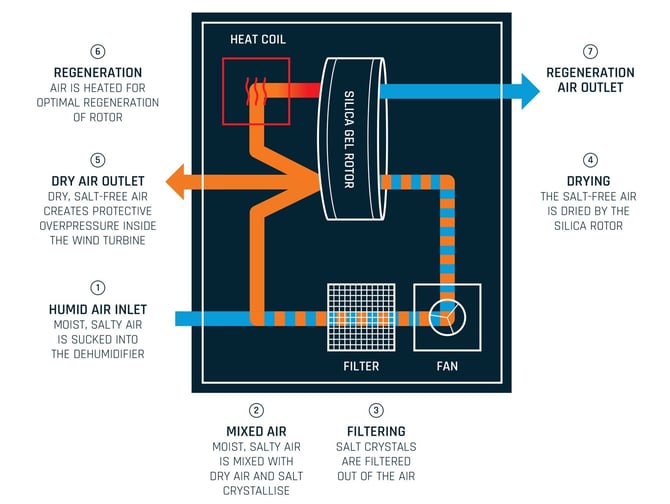
The process can be divided into four main steps:
1. Salt-laden air enters the unit
Ambient air from the surrounding coastal environment is drawn into the Desalter system.
This incoming air typically contains:
- Water vapour
- Salt particles
- Sea spray aerosols
- Other airborne contaminants
2. The air is dried using adsorption technology
The incoming air passes through a desiccant rotor, where moisture is removed from the air.
As the humidity level drops, the moisture surrounding airborne salt particles evaporates.
This is a critical part of the process because salt dissolved in microscopic water droplets cannot be effectively filtered.
3. Salt particles crystallise and are filtered
As the droplets dry out, the dissolved salt crystallises into solid particles.
These solid particles can then be captured by the filtration system before the air enters the protected area.
This is the core of the Cotes desalting principle:
- Moist salt aerosols are converted into dry salt crystals
- The crystals are removed through filtration
- Cleaner, drier air is supplied to the building
Watch the video
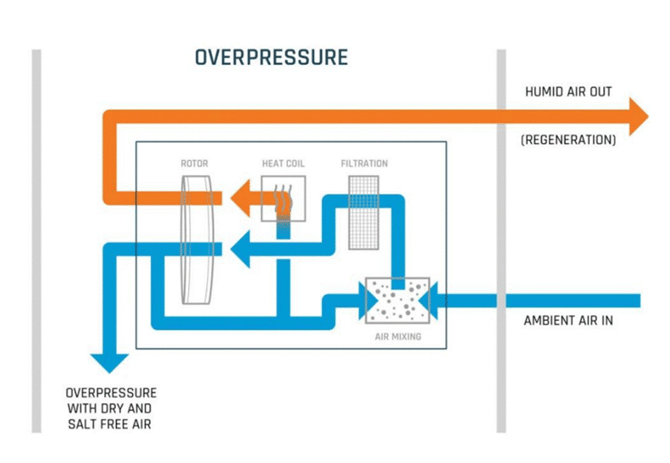
4. Dry air creates a protective overpressure
The treated air is supplied continuously to the protected space.
This creates a slight positive pressure inside the structure.
The overpressure helps prevent untreated outside air from entering through:
- Door openings
- Cable penetrations
- Ventilation leaks
- Building gaps
As a result, the internal environment remains dry and protected from salt ingress.
Why not simply use a filter?
Traditional filtration alone cannot efficiently remove microscopic seawater droplets suspended in the air.
Because the salt is dissolved within these droplets, it passes through many conventional filtration systems.
The Cotes Desalter first dries the droplets, converting the dissolved salt into solid crystals that can be filtered much more effectively.
This is why the combination of adsorption drying and filtration is essential.
Does the system continuously remove moisture?
Yes. The adsorption rotor operates continuously.
While one section of the rotor removes moisture from the incoming air, another section is regenerated using a separate regeneration airstream.
This allows the Desalter to provide uninterrupted protection around the clock.
Why is dry-air overpressure important?
The objective is not to dry the entire outdoor environment.
Instead, the Desalter creates a protected indoor air column by continuously supplying dry, treated air.
The slight overpressure reduces the amount of untreated marine air that can enter the structure, making the protection significantly more effective and energy-efficient.
What makes the Cotes Desalter different from a standard dehumidifier?
A standard dehumidifier primarily focuses on lowering humidity.
The Cotes Desalter combines:
- Adsorption dehumidification
- Salt reduction
- Air filtration
- Dry-air overpressure
This integrated approach allows the system to address both moisture and salt contamination, which are the two primary causes of corrosion in coastal and maritime environments.
What is the result?
The result is a stable indoor environment with:
- Lower humidity
- Reduced salt contamination
- Reduced corrosion risk
- Improved reliability of electrical and mechanical equipment
- Longer asset lifetime
By controlling both moisture and salt ingress, the Cotes Desalter helps protect critical infrastructure in some of the world's harshest operating environments.
Want to know more about the controler options for the Cotes Desalter units? Read more here